
Home Loan & Debt Strategy

Home Loan & Debt Strategy on the Northern Beaches

Structure your home loan and debt to improve cash flow, reduce interest and support your longer term financial goals.

A good home loan strategy is about more than simply finding a competitive interest rate. How your loan is structured, where you keep your savings and what you do with surplus cash flow can all make a significant difference over time.

Your home loan is likely to be one of your largest financial commitments, so how it is structured and managed can make a significant difference over time.

A good debt strategy isn’t simply about finding the lowest interest rate. It can involve how you use your offset, where you direct surplus cash flow, how quickly you repay debt and how your loan structure fits with future investment plans.

For many clients, the goal is to create a debt strategy that works alongside their broader financial plan, rather than treating the mortgage as a completely separate decision.

Debt Management & Strategy - Financial Services - Everyday Wealth

Making Your Home Loan Work More Effectively

Paying off your home loan isn’t just about making the minimum repayment each month. How your loan is structured, where you keep your savings and what you do with surplus cash flow can all make a significant difference over time.

For some people, the priority may be paying the mortgage down faster. For others, it may make sense to invest while continuing to reduce debt.

Features such as offset accounts, additional repayments and the way your loans are structured can also affect how efficiently your money is working.

The key is understanding the different options available and choosing an approach that fits with your broader financial goals.

✓ Reduce interest over time

✓ Make better use of surplus cash flow

✓ Pay your home loan down faster

✓ Build wealth alongside your mortgage

There Is More Than One Way to Manage Your Mortgage

The right approach to your home loan will depend on your income, cash flow, goals and what you’re trying to achieve over the longer term.

For some people, paying down the mortgage faster will be the priority. For others, maintaining flexibility or building wealth alongside the mortgage may be equally important.

What Is an Offset Account?

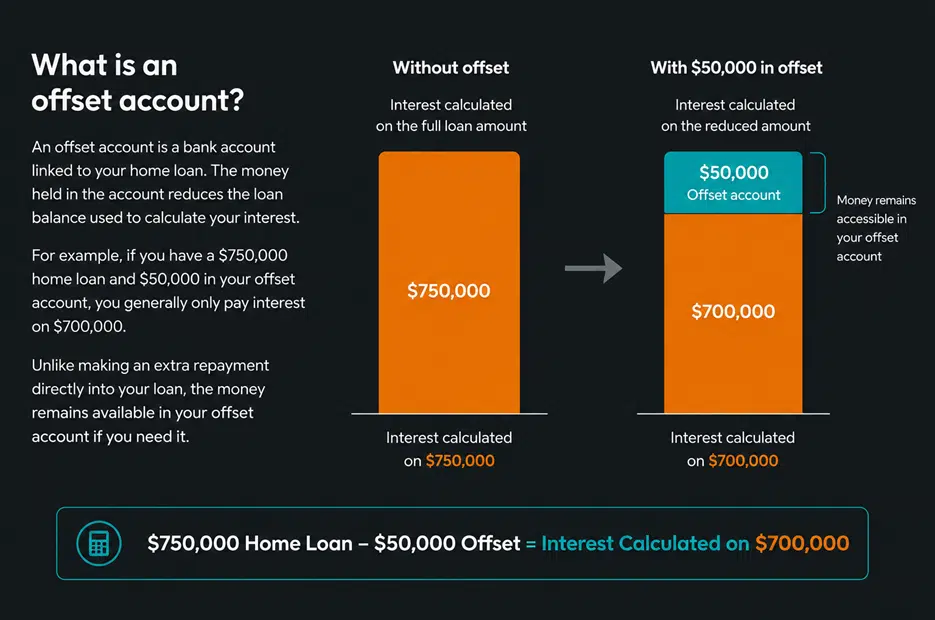
An offset account is a bank account linked to your home loan. The money held in the account reduces the loan balance used to calculate your interest.

For example, if you have a $750,000 home loan and $50,000 in your offset account, you generally only pay interest on $700,000.

Unlike making an extra repayment directly into your loan, the money remains available in your offset account if you need it.

See What Extra Repayments Could Save You

Estimate how making extra repayments or using an offset account could reduce the interest you pay and help you repay your home loan sooner.

CURRENT LOAN
Estimated time to repay -
Total interest -
EXTRA REPAYMENTS
Estimated interest saved -
Time saved -
New monthly repayment -
OFFSET ACCOUNT
Estimated interest saved -
Time saved -
Monthly repayment -
Both approaches can reduce the interest you pay.

Extra repayments reduce your loan balance directly, while an offset account reduces the balance used to calculate interest while keeping your savings accessible.

This is a simplified illustration only. It assumes the interest rate and repayments remain unchanged, extra repayments continue each month and the offset balance remains constant. It does not allow for loan fees, rate changes, redraws or other loan features. Actual outcomes will vary.

Want to Check Your Home Loan Repayments?

Is Paying Off Your Home Loan Faster Always the Best Option?

Paying less interest and becoming debt free sooner can be a great outcome. But that doesn’t necessarily mean every spare dollar should always go towards your mortgage.

Depending on your circumstances, surplus cash flow could potentially be used in several ways, including:

✓ Making extra home loan repayments
✓ Building savings in your offset account
✓ Investing outside super
✓ Making additional super contributions
✓ Using a debt recycling strategy

Often, the right approach is a combination of these strategies.

The important question isn’t simply “How quickly can I pay off my mortgage?”

It’s “What is the best use of my surplus cash flow to achieve my longer term goals?”

Getting Your Home Loan Structure Right

A competitive interest rate is important, but the way your loans are structured can be just as important over the longer term.

The right structure should reflect how you use your money today while also allowing for what you may want to do in the future.

✓ Offset vs redraw
Understand where to hold surplus cash and how each option works.

✓ Loan splits
Keep different parts of your borrowing separate where there is a reason to do so.

✓ Home loan vs investment debt
Avoid unnecessarily mixing private and investment borrowings.


✓ Principal & interest vs interest only
Make sure the repayment structure suits the purpose of the loan. 

✓ Refinancing
Review whether your existing loan, rate and features are still competitive and appropriate.

✓ Future flexibility
Consider future plans before restructuring debt, particularly if you may invest, move home or use equity later.

Good loan structure isn’t just about getting a cheaper rate. It’s about making sure your lending supports what you’re trying to achieve.

Your Home Loan Is Only One Part of the Picture

Your home loan is a major part of your financial position, but decisions about debt shouldn’t be made in isolation.

How much you repay, how much you keep in cash, whether you invest, how much you contribute to super and how your loans are structured can all affect your longer term position.

Looking at these decisions together can help you find the right balance between reducing debt, maintaining flexibility and building wealth for the future.

The goal isn’t necessarily to pay off your mortgage as fast as possible. It’s to make the best use of the money you have available.

We warmly welcome new clients and our door is always open.

Let us take the stress and hassle out of managing your financial goals so you can focus on the important stuff.

Scroll to Top