Transition To Retirement Strategy

Transition To Retirement Strategy

Access your super while continuing to work and create more flexibility around income, tax and retirement planning.

A Transition To Retirement (TTR) strategy may allow you to draw income from super while still working. Depending on your situation, this can create flexibility around cash flow, super contributions and retirement planning decisions.

✓ Potentially contribute more into super

✓ Maintain similar cash flow

✓ Improve tax efficiency

✓ Create greater flexibility before retirement

Book an initial conversation to explore whether a Transition To Retirement strategy may suit your situation.

What is a Transition To Retirement strategy

A Transition To Retirement (TTR) strategy allows some people to access part of their super while continuing to work.

Continue working
Keep earning while moving closer to retirement.

Redirect more into super
Potentially increase retirement savings over time.

Maintain similar cash flow
Use pension payments to help support day to day income.

The objective is not necessarily to receive more income today.

It is to use existing income more efficiently and potentially improve long term retirement outcomes.

Retirement Planning - Retirement Planning - Financial Services - Everyday Wealth

A typical TTR strategy may combine:

✓ Additional salary sacrifice contributions

✓ Transition To Retirement pension

✓ More efficient income structuring

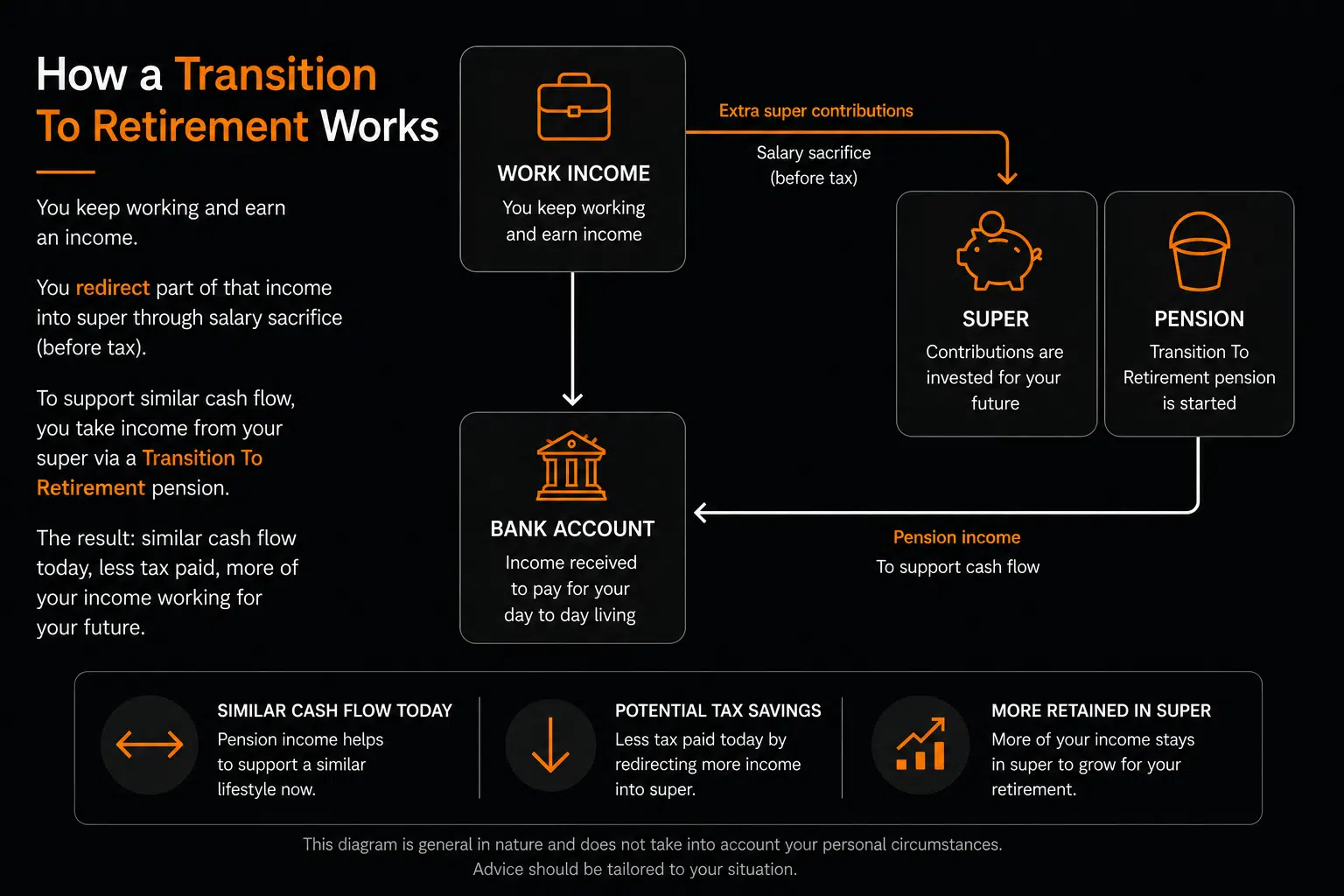
How a Transition To Retirement strategy works in practice

A Transition To Retirement (TTR) strategy allows some people to access part of their super while continuing to work.

At Everyday Wealth, our approach is often less focused on reducing work and more focused on improving how income flows.

In many cases, we explore whether clients may be able to maintain a broadly similar level of cash flow while increasing super contributions and improving long term retirement outcomes.

This may involve combining additional salary sacrifice contributions with a Transition To Retirement pension to create more flexibility around income and retirement planning.

The objective is not necessarily to receive more income today.

The objective is often to redirect income more efficiently and build retirement wealth without materially reducing lifestyle.

Like any strategy, suitability depends on age, employment income, contribution capacity and retirement goals.

✓ Maintain a similar level of cash flow while contributing more to super

✓ Create flexibility around income leading into retirement

✓ Improve tax efficiency where appropriate

✓ Build retirement wealth without materially reducing lifestyle


Example Of A Transition To Retirement Strategy

To make this more practical, here is a simplified example of how a Transition To Retirement strategy may work.

David is 61 and earning $100,000 per year.

Rather than simply taking all of his income as salary, he explores redirecting more income into super while using pension payments to help support his cash flow.

The objective is not necessarily to spend more.

Instead, the goal is to maintain a similar lifestyle today while potentially improving tax efficiency and retaining more wealth inside super over time.

Because outcomes can vary based on factors such as age, income, contribution limits and super balances, modelling and personalised advice can make a meaningful difference.

What does this mean?

A Transition To Retirement strategy helps answer a simple question:

Could your current income be working harder for your future?

Rather than relying on guesswork, different contribution and pension scenarios can be explored to understand what may improve long term retirement outcomes.

For many people, the objective is not to spend less.

It is to maintain a similar lifestyle today while potentially building greater flexibility for tomorrow.

Is a Transition to Retirement strategy right for you?

This strategy may be worth exploring if you would like to:

✓ Potentially contribute more into super

✓ Maintain similar cash flow

✓ Support day to day income with pension payments

✓ Improve tax efficiency

✓ Build confidence approaching retirement

✓ Create more flexibility for the years ahead

Start with a clearer strategy

The first step is understanding how your current income, super and retirement position work together.

From there, different contribution and pension scenarios can be modelled to explore whether a Transition To Retirement strategy may improve tax efficiency, support cash flow and strengthen long term retirement outcomes.

You can also learn more about Transition To Retirement pensions and retirement planning through Moneysmart.

Because the right approach depends on factors such as age, income, super balances and contribution limits, personalised advice can make a meaningful difference.

We warmly welcome new clients and our door is always open.

Let us take the stress and hassle out of managing your financial goals so you can focus on the important stuff.

Scroll to Top