A simple way to improve your position while you’re still working
For many people in their late 50s and early 60s, retirement is getting closer.
However, there’s often a gap.
You’re still working.
You’re earning income.
But you’re also starting to think about how to transition into retirement.
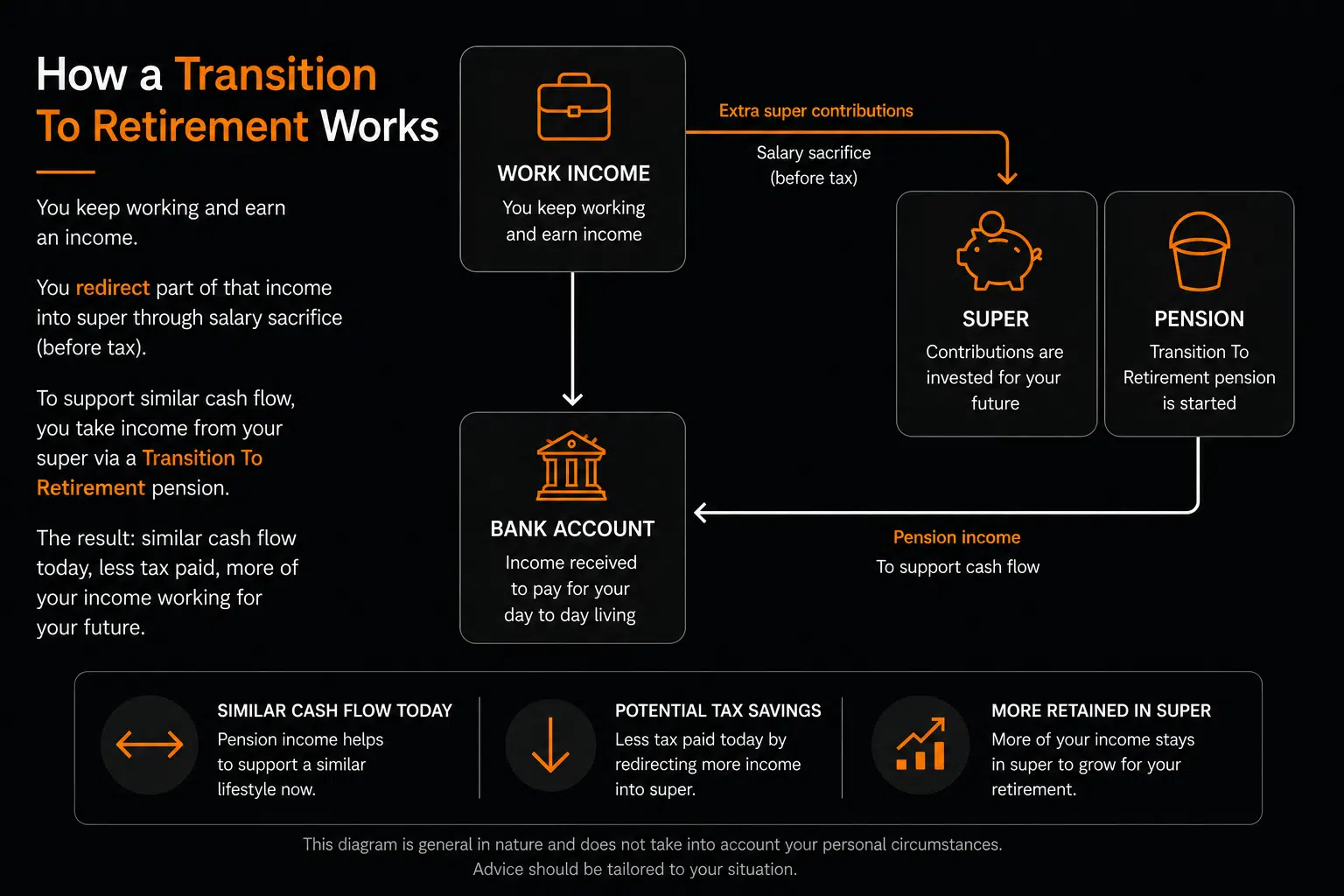
A transition to retirement strategy can be a way to improve your position during this period, often without changing your day-to-day cash flow.
What is a transition to retirement strategy?
A transition to retirement strategy involves:
- contributing more of your salary to super
- while replacing some of your take-home income with a super pension
In simple terms:
- More money goes into the super
- Some money comes back out
So your overall income stays similar, but the structure improves.
You may also hear this referred to as a TTR strategy, or an “income swap” approach.
Why this matters
Super is taxed differently from personal income.
Because of this:
- Contributions to super are generally taxed at 15%
- Salary and wages are taxed at your marginal tax rate
- Income drawn from super (after age 60) is generally tax-free
So by restructuring how income flows, a transition to retirement strategy may:
- Reduce overall tax
- Increase your super balance
- Improve your long-term retirement position
A simple example
Let’s say someone earns $120,000 per year.
Instead of taking all income as salary:
- They increase contributions into super to around $30,000 (including employer contributions)
- Then draw around $20,000 from a super pension
The result:
- Their take-home income stays broadly the same
- More money is directed into super each year
- And some income is now coming from a more tax-effective source
Because of the difference in how income is taxed:
- Contributions to super are taxed at 15%
- While salary may be taxed at a higher marginal rate
This can create annual tax savings while maintaining the same lifestyle.
In many cases, this can be structured so that your weekly cash flow remains similar while improving your long-term position.
Using unused contribution caps
Another layer to this strategy is the ability to use unused concessional contribution caps from previous years.
For some people, this allows:
- Higher contributions to the super
- additional tax savings
- and a stronger boost to their overall position
This can be particularly valuable in the years leading up to retirement, when income is often at its highest.
Where this becomes relevant
This tends to come into play when:
- You are approaching or over age 60
- You are still working
- You have a consistent income
- You are building toward retirement
It also forms part of broader retirement planning advice and long-term superannuation advice.
Things to be aware of
There are rules around:
- contribution limits
- pension drawdown requirements
- eligibility based on age
So this is not something to implement without a clear plan.
The ATO provides further detail on super and transition to retirement strategies here:
Transition to retirement income streams
The bigger picture
A transition to retirement strategy isn’t just about the current year.
It’s about the period leading up to retirement.
For many people, this is:
- the final opportunity to build super
- a time when income is still high
- and a chance to improve their overall position
The takeaway
A transition to retirement strategy isn’t about changing your lifestyle.
It’s about changing how your income is structured.
For many people, this can mean:
- maintaining the same weekly cash flow
- reducing tax along the way
- and building a stronger position for retirement
Next steps
If this has raised a few questions, that’s usually a good sign.
This type of strategy isn’t about making drastic changes; it’s about understanding how your income and super can work together more effectively.
If you’d like to see how this could apply to your situation, we can map it out properly and run through the numbers.
As always, this is general information only and does not take into account your personal circumstances.